

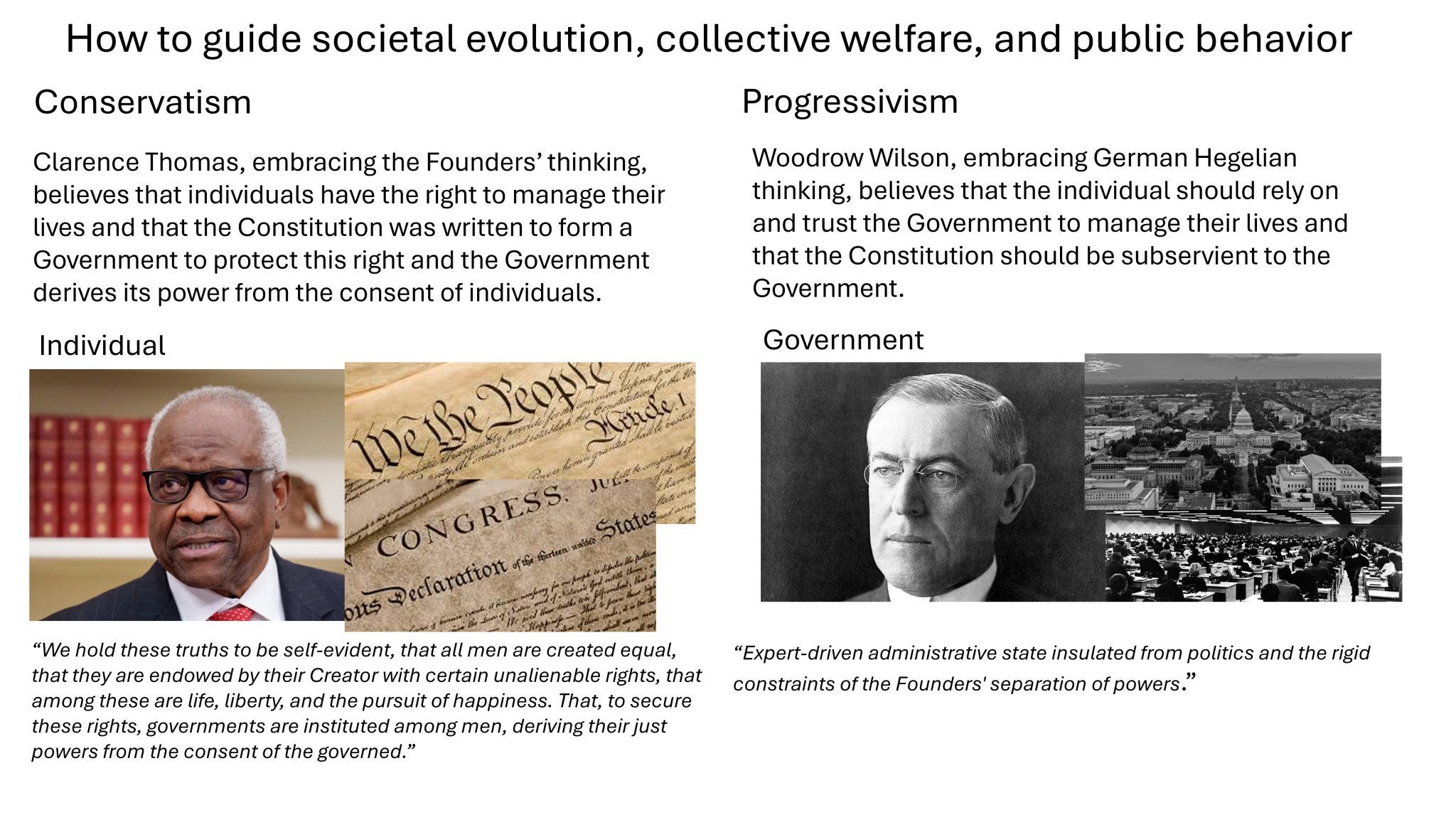
Drawing on Hegelian philosophy, Woodrow Wilson was the pivotal architect and key implementer of a fundamental transformation in American governance: shifting from the Founders’ vision of natural rights secured by a limited government accountable to the people, to Progressivism — a system of unelected experts who manage and direct the individual.
Wilson advocated undermining the Constitution’s fixed limits, the separation of powers, and the rule of law—core safeguards of liberty—in favor of unified, efficient executive and administrative authority. He championed expert-driven independent commissions vested with expansive rulemaking, enforcement, and adjudicative powers, deliberately insulated from direct political and electoral accountability.
Wilson’s Progressive vision extended to race through explicit white supremacy. His History of the American People glorified the Ku Klux Klan and condemned Reconstruction as rule by “ignorant negroes.” In 1913, he resegregated the federal civil service, demoting and dismissing Black employees.
His Fourteen Points and leadership at the 1919 Paris Peace Conference attempted to impose Progressive internationalism. He championed a League of Nations as a new global administrative body of experts to enforce peace and transcend traditional power politics. He was instrumental in the Treaty of Versailles, which imposed harsh terms on Germany while creating unstable new states in Europe.

