

A great post on wealth and economics by Brivael Le Pogam
Bernie Sanders says the top 1% owns more than the bottom 93%, that fewer than a thousand billionaires got $2.2 trillion richer last year, and that it’s “obscene.”
It’s the most seductive and most wrong economic argument of our time. Let me explain why.
First, wealth distribution follows a power law. Always. Everywhere. Books, music, startups, followers on X, goals in soccer. A small minority captures most of the value. That’s not a bug of capitalism. It’s the mathematical signature of every system where value gets created.
So the only question that matters isn’t “how big is the rich’s slice?” It’s “is the cake growing, and is the slice of the poorest growing with it?”
And the answer is yes. In 1990, more than one human in three lived in extreme poverty. Today it’s about one in ten. During exactly the period when billionaires multiplied.
Bernie shows you the slice. He never shows you the cake.
Second thing he won’t tell you: past a certain level, wealth stops being consumption. It becomes capital allocation.
Elon Musk isn’t sleeping on a pile of cash. He owns stakes in Tesla, SpaceX, xAI. Jeff Bezos owns Amazon stock. That “$2.2 trillion” isn’t sitting in a checking account. It’s factories, rockets, data centers, millions of jobs. Nobody can eat $100 billion. You can only decide where to invest it.
Once you understand that, the whole debate changes. The real question becomes: who allocates capital better?
The people who built Amazon, SpaceX and Nvidia? Or politicians?
A 5% wealth tax isn’t “taking money from the rich.” It’s taking investment decisions away from people who proved they can create value and handing them to people who proved the opposite.
Because the fundamental difference between an entrepreneur and a politician is consequences.
The entrepreneur invests his own money. If he allocates badly, he loses everything. The market corrects him brutally, no appeal. That’s why most startups die: the system kills bad decisions.
The politician invests other people’s money. If he allocates badly, nothing happens. Worse, he gets a bigger budget to “fix the problem.”
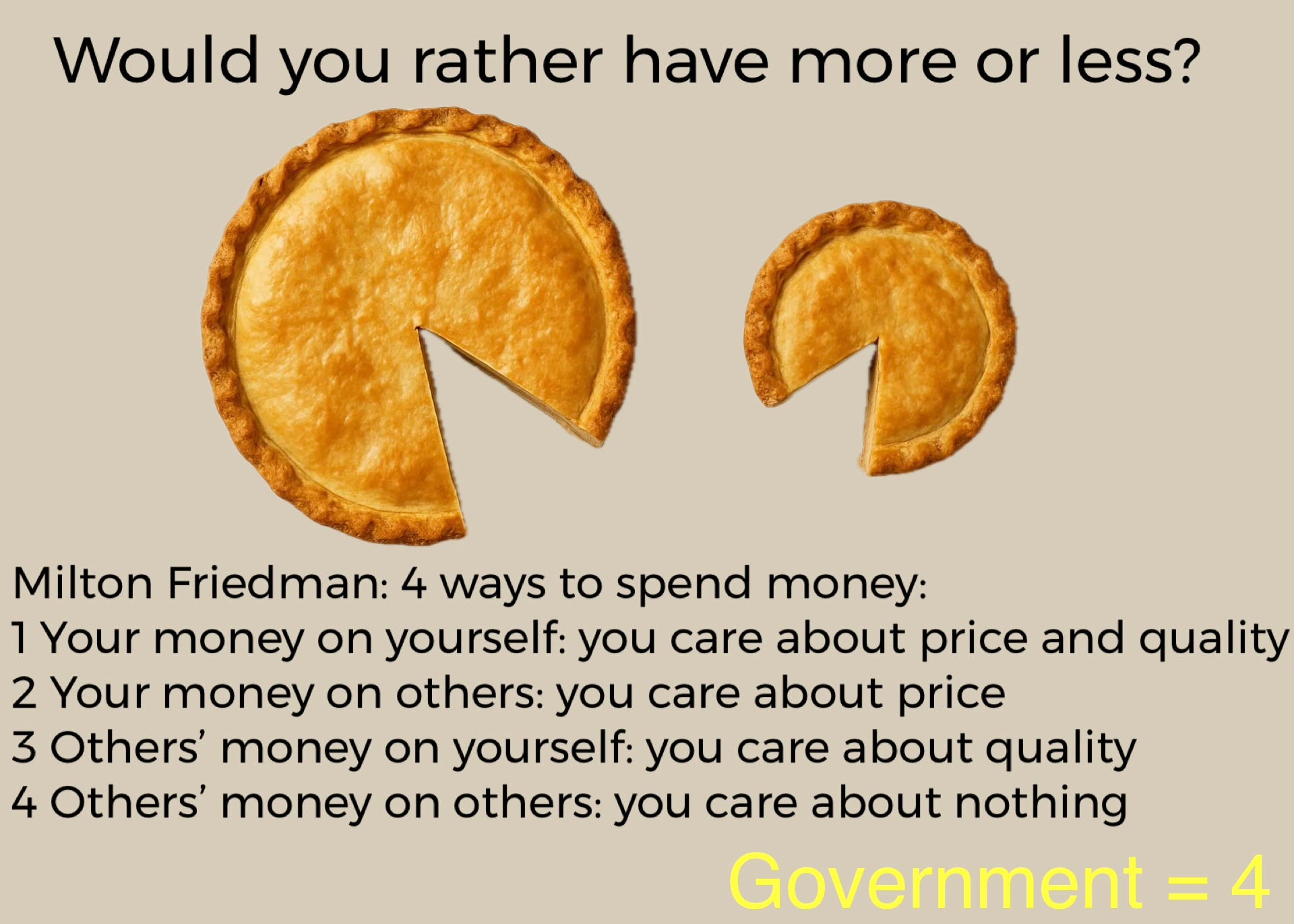
Milton Friedman put it better than anyone. There are four ways to spend money. Your money on yourself: you care about price and quality. Your money on others: you care about price. Others’ money on yourself: you care about quality. Others’ money on others: you care about nothing.
Government is the fourth box. By design.
Perfect example: California high-speed rail. Approved in 2008 for about $33 billion. Current estimated cost: over $100 billion. Passengers carried: zero. No entrepreneur would have survived that. The politicians who pushed it built careers on it.
And when allocation has no consequences, it eventually finds a buyer. A politician who controls billions without accountability becomes the most profitable target in the world for anyone who wants to steer that money.
The irony is that the left that rails against billionaires is itself funded by billionaires. George Soros is one of the biggest Democratic donors in history. The Gates Foundation shapes public health policy across the planet.
Politicians don’t fight billionaires. They pick their own. The ones who fund the state over the ones who compete with it.
So if we actually want fewer poor people, we have to stop judging ideas by their intentions and start judging them by their results. And the results are brutally clear.
China, 1978: Deng Xiaoping opens the economy to markets. More than 800 million people escape extreme poverty. The largest retreat of misery in human history. Not through redistribution. Through the freedom to build.
India, 1991: liberalization. Same movie.
South Korea and North Korea: same people, same language, same starting point in 1953. One became one of the most advanced economies on earth. The other has famines.
Poland and Ukraine: comparable living standards in 1990. Today the average Pole is more than three times richer than the average Ukrainian.
Argentina: a year and a half of liberalization, and the poverty rate falls from over 50% to around 30%.
No country in history escaped poverty by punishing the people who build. Every single one did it by letting them build.
And if you want to see what Bernie’s program looks like in real life, you don’t have to imagine it. It exists. It’s called France. We’ve been running it for 45 years.
Mass nationalizations in 1981. Two years later, Socialist president Mitterrand has to reverse course into austerity.
Retirement at 60. The 35-hour workweek.
A wealth tax for 35 years. Hundreds of wealthy households left every year for Belgium, Switzerland, London, taking their capital, their companies and their future taxes with them. Macron finally scrapped it in 2018.
Hollande’s 75% tax: raised a few hundred million, drove talent out, abandoned after two years.
One of the highest tax burdens in the OECD. Public spending around 57% of GDP, a record in the developed world.
Last balanced budget: 1974. Public debt: over €3.4 trillion. Mass unemployment for four decades.
If taxing the rich and growing the state made people prosperous, France would be the richest country on the planet.
It isn’t. GDP per capita in France is barely more than half of America’s. It’s lower than Mississippi, the poorest state in the US. Not a single global tech giant. Our best engineers build Silicon Valley instead. I’ve been going back and forth between Paris and San Francisco for years. I see it every week.
And California is about to replay the movie. Prop 40, on the ballot November 3rd, would take 5% of billionaires’ net worth. Even Gavin Newsom, a Democratic governor, opposes it. The state’s own nonpartisan budget analyst warns that income tax revenue could drop every year if the wealthy leave. Larry Page, Sergey Brin and Peter Thiel have reportedly already started moving their assets out.
You don’t fight poverty by shrinking the top. You fight it by growing the cake.
Bernie wants a society where nobody has too much. I want a society where nobody has too little.
The first has been tried everywhere and produces equality in stagnation. The second lifted a billion people out of misery.
Choose.

