

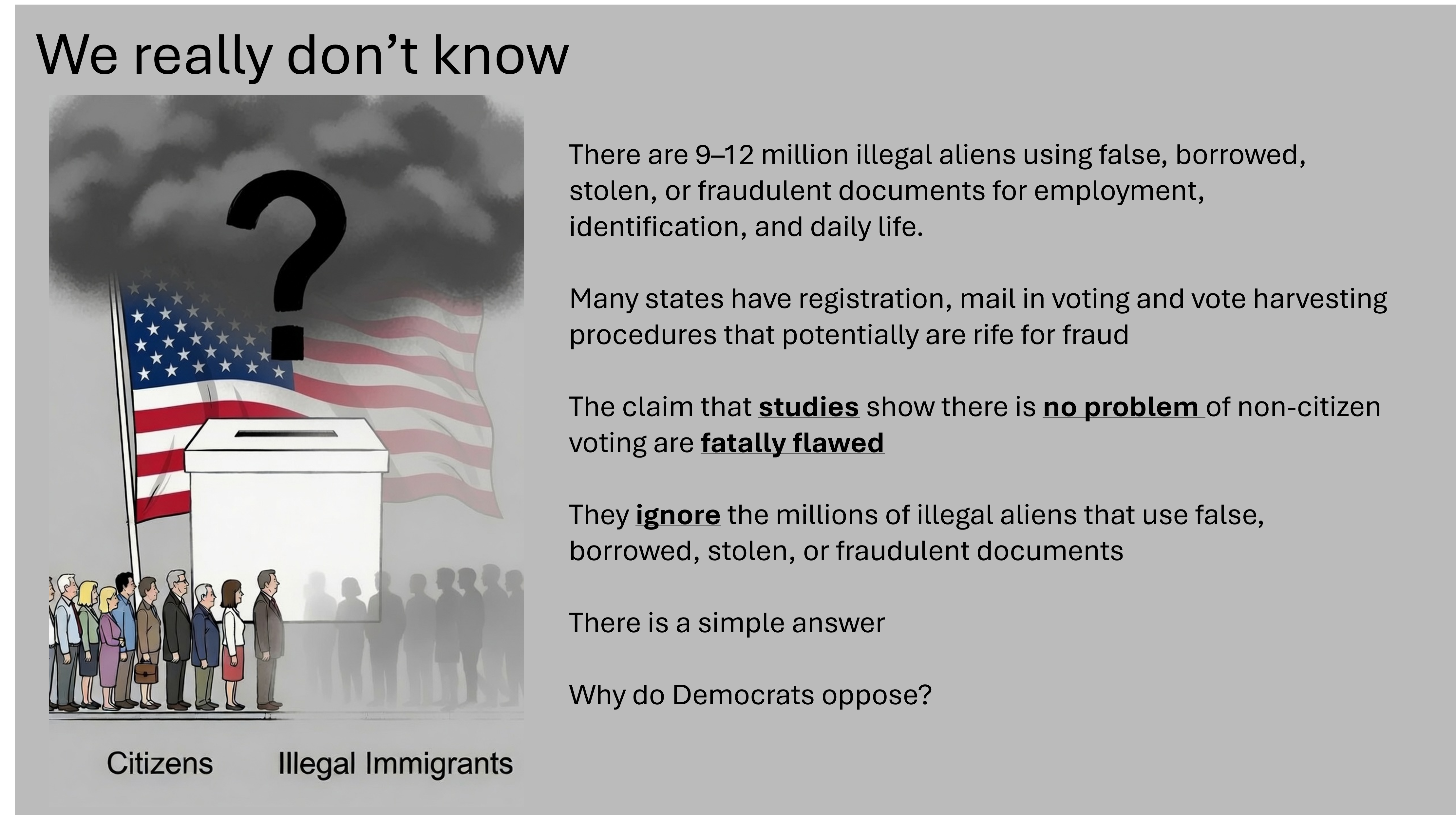
Ensuring the integrity of voting is essential for public confidence in our federal elections. One important question is the potential extent of non-citizen voting.
Estimates indicate there are up to 12 million undocumented adults in the United States who are largely outside the active federal immigration tracking system and that use false, borrowed, stolen, or fraudulent documents for employment, identification, and daily life.
In several states, individuals are automatically registered to vote when obtaining or renewing a driver’s license unless they explicitly opt out or self-identify as a non-citizen. Additionally, certain states automatically send mail-in ballots to all registered voters and permit third-party ballot collection (sometimes called ballot harvesting), with varying levels of restrictions.
States with automatic mail ballots include: California, Colorado, Hawaii, Nevada, Oregon, Utah, Washington, and others with broad policies. Several of these also allow third parties to return ballots on behalf of voters.
Given the combination of a large undocumented population with questionable documents, automatic registration mechanisms, widespread mail-in voting, and ballot collection practices, there is a plausible pathway for non-citizens to end up registered and casting ballots — whether intentionally or through error.
While some claim this issue has been thoroughly investigated and that audits show non-citizen voting is extremely rare, those studies have a fatal flaw: They only compare voter rolls against federal databases of known legal immigrants or naturalized citizens. They ignore undocumented individuals who are not in those systems and who may be using fraudulent identification.
A relatively straightforward solution is a well-designed pilot study. Select one or more precincts with a priori risk factors (high immigrant concentrations, automatic registration, mail-in voting). Draw a statistically significant random sample of registered voters or cast ballots, then commit sufficient resources to thoroughly verify citizenship and eligibility.
The study would not be used to prosecute or punish individuals. Participants could receive incentives for cooperation. A sample of approximately 3,000–5,000 voters in a high-risk district like California’s 40th Congressional District would provide a meaningful signal about whether non-citizen voting reaches around 1% or higher.
The cost would be modest compared to the value of credible, transparent data on election integrity — data that could either confirm concerns or reassure the public.
Follow on X: @rggonzoX