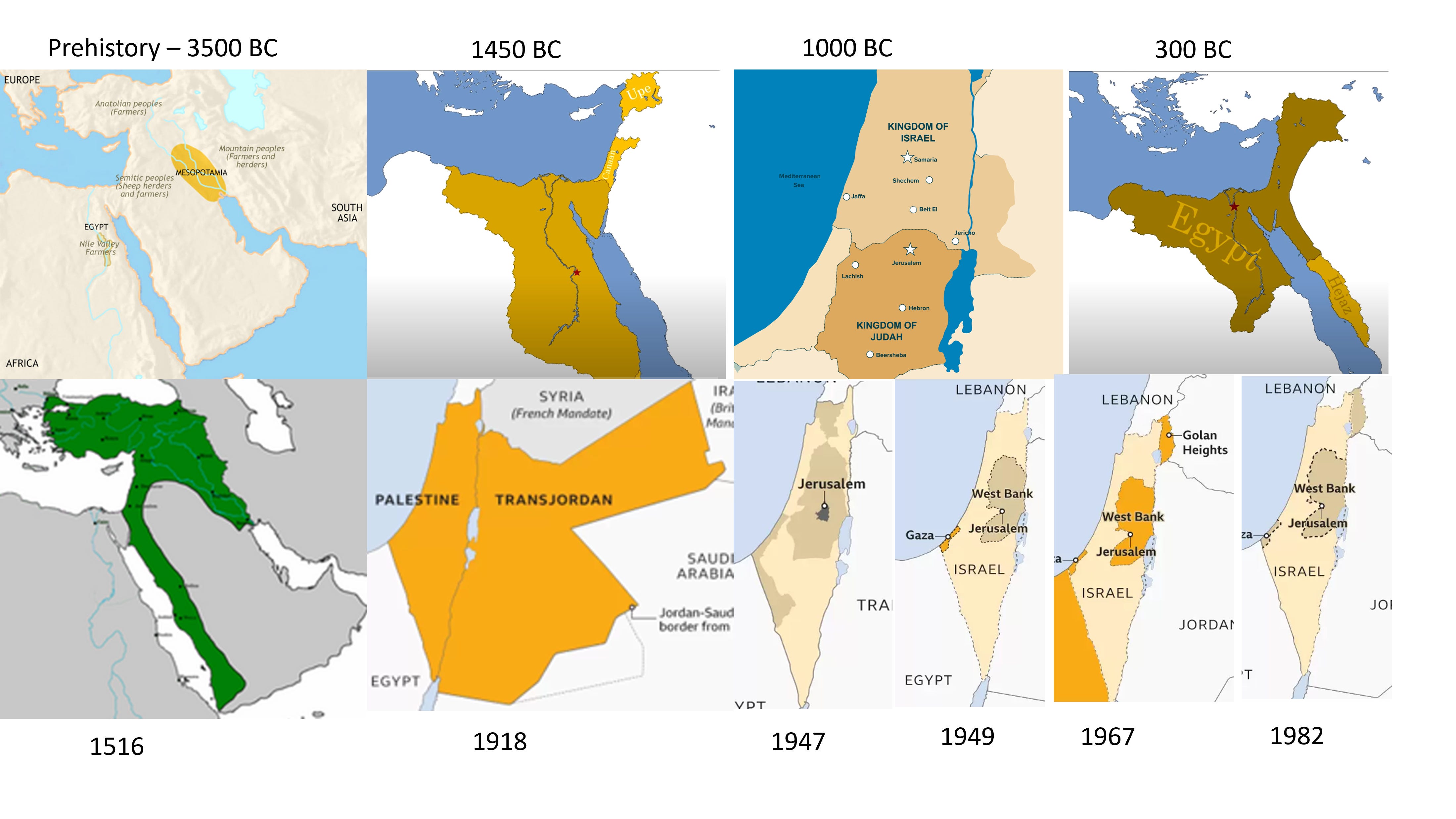
There has never been a sovereign Palestinian Arab state. The land of Israel has been home to Jews for over 3,000 years, the birthplace of Judaism—one of the world’s first monotheistic faiths. Christianity and Islam emerged later in the same region.
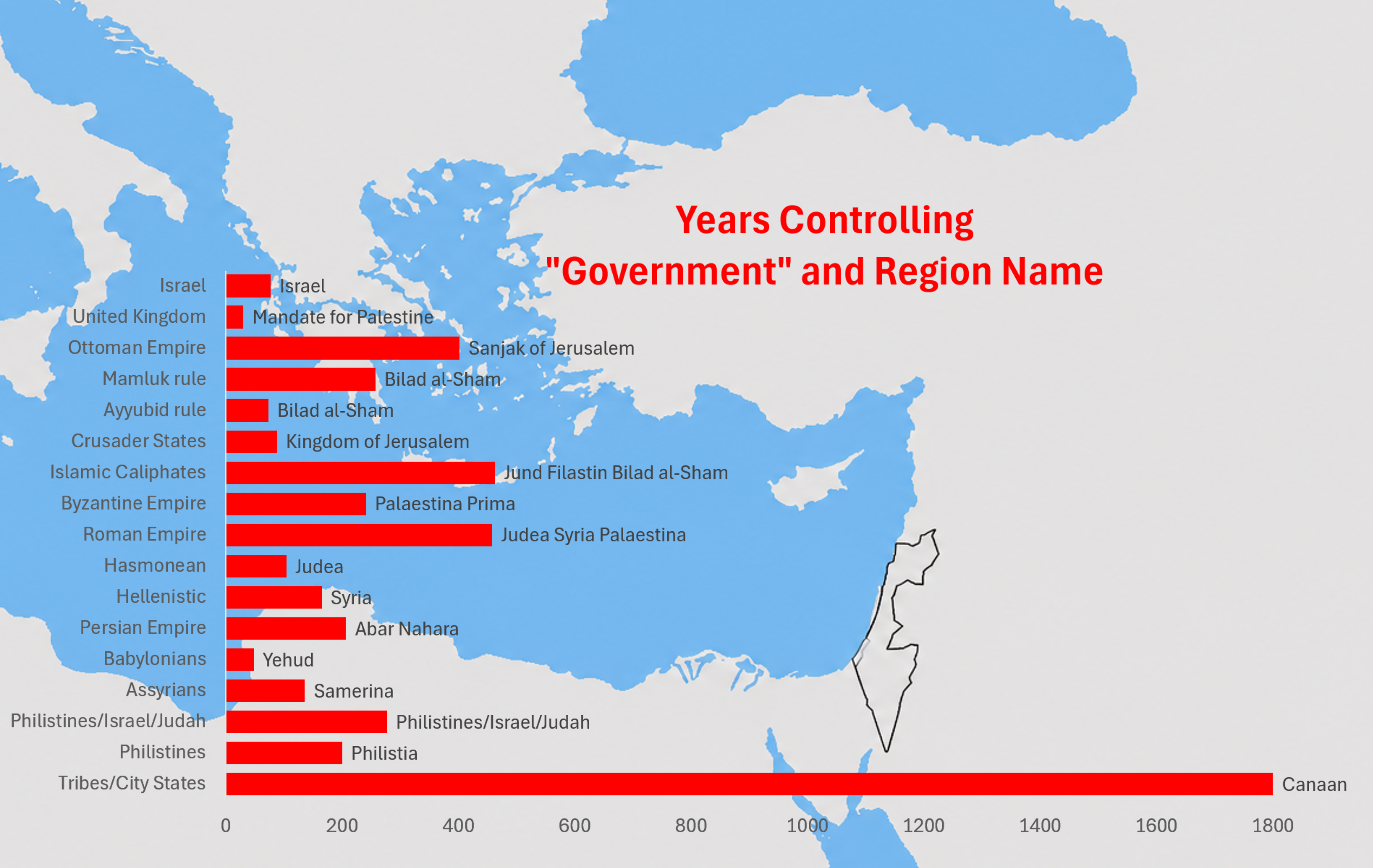
As shown in the attached timeline chart, this small strip of land has been controlled by a succession of empires and powers: Canaanite tribes, Israelites, Philistines, Assyrians, Babylonians, Persians, Greeks, Romans (who renamed it Syria Palaestina after crushing Jewish revolts), Byzantines, Islamic Caliphates, Crusaders, Mamluks, Ottomans, and finally the British. Jews, Christians, and Muslims lived there under these rulers, but the population shifted with conquests, migrations, and expulsions.
Prior to World War I, the area was part of the Ottoman Empire, primarily administered as the Sanjak of Jerusalem. After the Ottoman defeat, the British Mandate for Palestine (1920–1948) was established. The Mandate incorporated the Balfour Declaration, supporting a Jewish national home in recognition of Jewish historical ties and the need for refuge after centuries of European pogroms. During this period, Jews immigrated and legally purchased land, often from absentee owners. Violence flared, but no formal agreement was reached on dividing the territory.
In 1947, the United Nations voted to partition the Mandate into a Jewish state and an Arab state (with Jerusalem internationalized). Jewish leaders accepted the plan despite its limitations. Arab leaders rejected it and, upon Israel’s declaration of independence in 1948, launched a war to destroy the new state. Israel prevailed. During the fighting, approximately 700,000 Arabs fled or were expelled (many encouraged by Arab leaders expecting quick victory). At the same time, roughly 850,000 Jews were expelled or fled persecution from Arab countries, most finding refuge in Israel.
Israel became a thriving democracy with a 20% Arab citizen population enjoying equal legal rights. The Arab states that attacked it repeatedly failed (1948, 1967, 1973). The displaced Arabs who ended up in Gaza, the West Bank, and neighboring countries were largely denied full integration by those Arab states, who preferred to keep the refugee issue alive as a political weapon.
Displacements are tragic and common in history—consider the Native Americans, the millions displaced after World War II, or the Jewish exiles from Arab lands. The world eventually draws lines to move forward. The 1948 armistice lines (or subsequent negotiated borders) provide a reasonable starting point. Arabs in Gaza and the West Bank could have built prosperous societies there, as Israel did from far less promising conditions. Instead, governance by rejectionist groups prioritizing Israel’s destruction has led to repeated cycles of violence.
Insisting on a “right of return” for millions of descendants to Israel proper is unrealistic and dangerous. It would eliminate the Jewish majority and the state’s character as a safe homeland for Jews—the very purpose of its founding after 2,000 years of diaspora and the Holocaust. Past is past; mutual recognition, secure borders, and peaceful coexistence are the only viable path.