

Great article-
Commentary
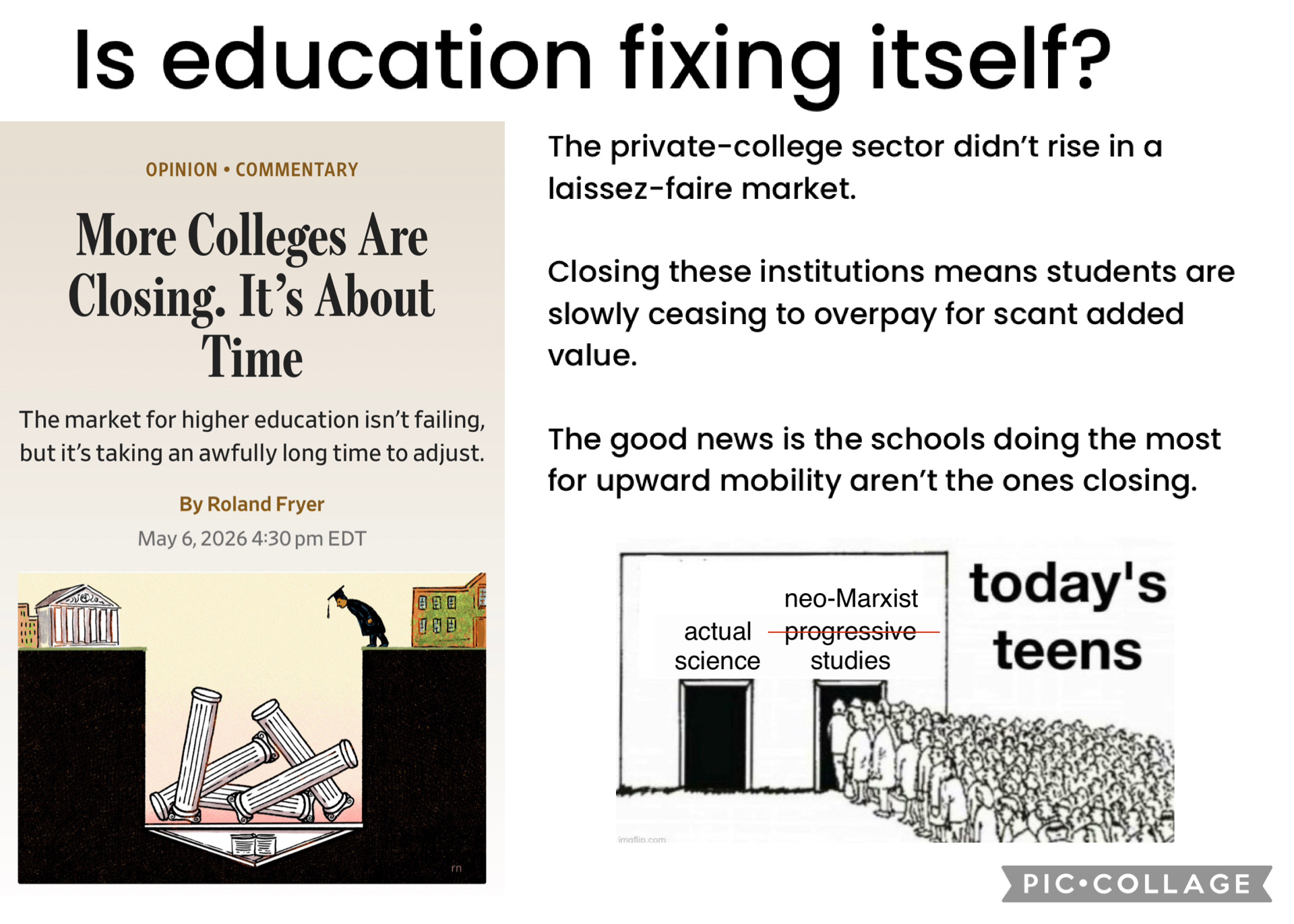
More Colleges Are
Closing. It’s About
Time
The market for higher education isn’t failing,
but it’s taking an awfully long time to adjust.
By Roland Fryer
UTC-04:00
Hampshire College, alma mater of filmmaker
Ken Burns, announced in April that it will close
after the fall semester. Sterling College, a 130-
acre working farm in northeastern Vermont, will
graduate its final class in May. The Huron
Consulting Group projects that 442 private
nonprofit colleges enrolling roughly 670,000
students are at risk of closing or merging within
a decade. The instinctive response is elegiac:
lament the shuttered campus, mourn the futures
it might have made, hope for rescue. Mr. Burns
called Hampshire’s closing “an extraordinary
loss.”
Is it just me, or is this good news for America?
Closing these institutions means students are
slowly ceasing to overpay for scant added value.
If more market correction is to come, that tells us
something important—about higher education
and about other education sectors we have built
to avoid correction altogether. The question isn’t
how to save these institutions. It is how to
accelerate market forces.
The private-college sector didn’t rise in a laissez-
faire market. It was built by federal loan
programs, the postwar college wage premium
and decades of expanding demand. In that
environment, “more college seats” and “more
social value” came to mean the same thing. They
weren’t.
Tuition and fees have outpaced overall inflation
for decades, and the strain is no longer
theoretical. Robert Kelchen, a professor of
education at the University of Tennessee,Knoxville, found in his analysis of college
finance data for fiscal 2024 that 31% of private
nonprofit institutions posted losses. Moody’s
downgraded St. Michael’s College in Colchester,
Vt., to junk in 2022. This isn’t a story about the
demographic cliff. The trouble was here first.
The good news is the schools doing the most for
upward mobility aren’t the ones closing. A
mobility report card study shows that schools
such as California State University, Los Angeles
and Stony Brook University, on New York’s
Long Island, pair relatively high access for low-
income students with strong success rates,
producing mobility rates—the percentage of
students who come from the bottom fifth of the
income distribution and end up in the top fifth—
of 9.9% and 8.4% respectively. The costs are
wildly different: average annual cost on the
College Scorecard is $3,967 at Cal State Los
Angeles, $18,784 at Stony Brook and $25,239 at
St. Michael’s. The point isn’t that every private
college underperforms every public college. It is
that upward mobility is available, at scale,
outside the prestige hierarchy and often at much
lower prices.
Selectivity predicts selection. It doesn’t reliably
predict value for the typical student. The
foundational result in this literature is Stacy Dale
and Alan Krueger’s 1999 paper, which used a
matched-applicant design—comparing students
with others who applied to and were admitted by
the same set of colleges—and found that the
earnings premium from attending a more
selective school essentially vanishes. They did
find one notable exception: For black, Hispanic
and first-generation students from low-income
families, selectivity did predict higher earnings.
That heterogeneity isn’t what the defenders of
small private liberal-arts colleges are arguing
about. The schools that move minority and low-
income students into the labor-market premium
Ms. Dale and Mr. Krueger identified are more
akin to Princeton and Stanford, not Hampshire
and Sterling. A more recent paper by Jack
Mountjoy and Brent Hickman, using Texas
administrative earnings records, finds the same
thing with cleaner data and a more robust
identification strategy.
That doesn’t mean colleges are interchangeable.
It means that when weak private institutionscharge high prices while delivering little value,
the eventual enrollment loss and closing aren’t a
market failure. They are revealed preference
doing what it’s supposed to do. Recent analysis
of postsecondary enrollment trends finds exactly
this: The institutions losing students are
concentrated among the lowest-value-add
colleges.
A common objection is that earnings are too
narrow a measure. Many argue that college
produces transformation, citizenship, character—
things a wage record can’t capture. They’re right
that earnings aren’t everything. But they’re
wrong that the closing schools have any
comparative advantage in producing them. The
Gallup-Purdue Index, surveying more than
30,000 graduates on workplace engagement and
life satisfaction, finds that institutional type—
private vs. public, selective vs. not—explains
almost none of the variation. The same is true for
civic engagement, marriage and health.
None of this makes closing painless. A study
with the National Student Clearinghouse
Research Center finds that students who
experience a closing are 71% less likely to be
enrolled elsewhere after one month and 50% less
likely to complete a credential than matched
peers who didn’t experience a closing. On the
other side of the ledger sits a much larger pool of
future students who would otherwise spend tens
of thousands of dollars on a low-value education.
Keeping these institutions alive isn’t progressive
—it’s a transfer from poorly informed future
students to incumbent institutions.
This correction almost certainly won’t reach the
Ivy League. Researchers Raj Chetty, David
Deming and John Friedman find that “Ivy Plus”
admission has no significant effect on mean
income rank at age 33 but raises the probability
of reaching the top 1% of earnings by roughly
50%. That is a lottery ticket for which the prize
is a 40-year annuity at top-1% income. Discount
it at any reasonable rate, and the price of
admission looks like a bargain.
The interesting question isn’t the top of the
distribution. It is the vast tier in between—the
schools that are neither dying small private
institutions nor lottery-ticket Ivies. Markets
deliver competitive outcomes when buyers can
see what they are buying, when they can walksee what they are buying, when they can walk
away cheaply if they were wrong, and when they
update their views in light of new information.
The market for higher education is working on
all three counts—but slowly. Information is
buried, switching is costly, and teenagers don’t
automatically keep up on statistics about their
own futures. The closings we are witnessing are
a decade of accumulated student decisions
finally adding up.
Last month a first-generation college student
from Nebraska pitched me on a startup to fix
this. It was the 100th such pitch I’ve heard on the
subject in the past couple of years. My answer
was the same as the preceding 99: There are
already scores of consumer-facing apps in this
space and hundreds of digital tools across the
broader landscape, and students are still walking
into bad enrollment decisions. The information
exists. Artificial-intelligence chatbots are doling
out advice. What is missing, at scale, is the right
kind of conversation.
In a field experiment my team and I ran in
Houston in 2014, we put graduation rates,
postgraduation earnings and full cost in front of
high-school seniors at the moment they were
choosing where to apply. The numbers alone
didn’t move them much.
Information-only interventions across the
broader literature show the same pattern. The
information-only arm of Eric Bettinger’s H&R
Block FAFSA experiment and Kelli A. Bird’s
800,000-student text-messaging trial both
produced null effects at scale. In contrast,
economist Christine Mulhern’s 2023 paper finds
that individual high-school counselors have
causal effects on educational attainment
comparable in magnitude to teachers. We need
tools that do what a good counselor does, at the
scale a human counselor never could, with the
warmth a chatbot can’t yet accomplish.
We should do all we can to accelerate market
forces in higher education. The real scandal isn’t
that hundreds of colleges are in danger of closing
—it is that we have designed K-12 so that their
equivalents never will.
Mr. Fryer, a Journal contributor, is a professor
of economics at Harvard, a founder of Equal
Opportunity Ventures and a senior fellow at the
Manhattan Institute.