IEEPA defines an economic emergency as an "unusual and extraordinary threat" to the U.S. national security, foreign policy, or economy, originating in whole or substantial part outside the United States.
IEEPA gives the President authority to declare an emergency and then to investigate, block during the pendency of an investigation, regulate, direct and compel, nullify, void, prevent or prohibit, any acquisition, holding, withholding, use, transfer, withdrawal, transportation, importation or exportation of, or dealing in, or exercising any right, power, or privilege with respect to, or transactions involving, any property in which any foreign country or a national thereof has any interest.
Trump used IEEPA to claim “emergencies” and to impose tariffs on Countries around the world. These tariffs were imposed arbitrarily and inconsistently and were repeatedly increased and decreased, often with no apparent connection or relationship to any factor potentially relate to an emergency. One glaring example was an increase in Canadian tariff’s as a result of a Canadian province producing and airing an advertisement that was unflattering to the President.
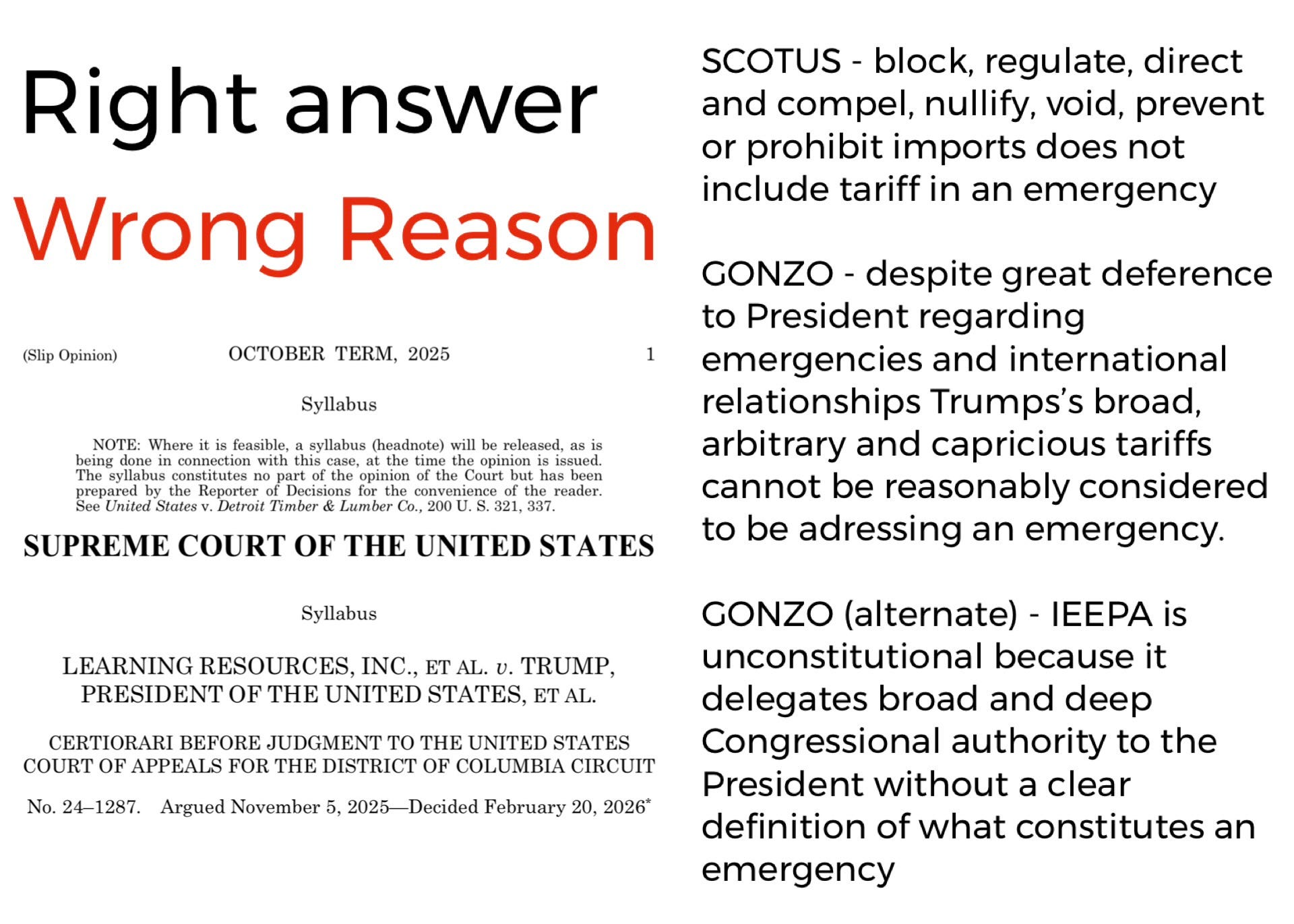
SCOTUS recently ruled that Trump’s tariffs under IEEPA were not allowed because imposing tariffs was not specifically listed under President’s authority and that they could not be construed as within the Presidents authority to regulate trade under IEEPA language.
I think SCOTUS’s ruling was off. Their parsing of a very broad list of actions to determine the President could do all sorts of things to stop imports, but he could not impose tariffs seems a weak argument. There would have been two better arguments to support the decision.
I think the best decision SCOTUS could have made in this case would have been that, even though they grant the President very broad deep authority when it comes to emergencies and international relationships, claiming that there is an emergency under IEEPA, given the broad, arbitrary and capricious way thatTrump has instituted these tariffs, was invalid.
An alternative decision would have been to decide that IEEPA itself is unconstitutional because it lacks any meaningful definition of what constitutes an emergency and therefore violated the non-delegation doctrine, essentially giving too much power to the President to declare emergencies.
This failure to insist the Congress provide clear and unambiguous definitions and articulations of intent will continue to lead to confusion and uncertainty. An example of this is the President’s immediate announcement that he will now impose 15% tariffs on Countries under Section 122.
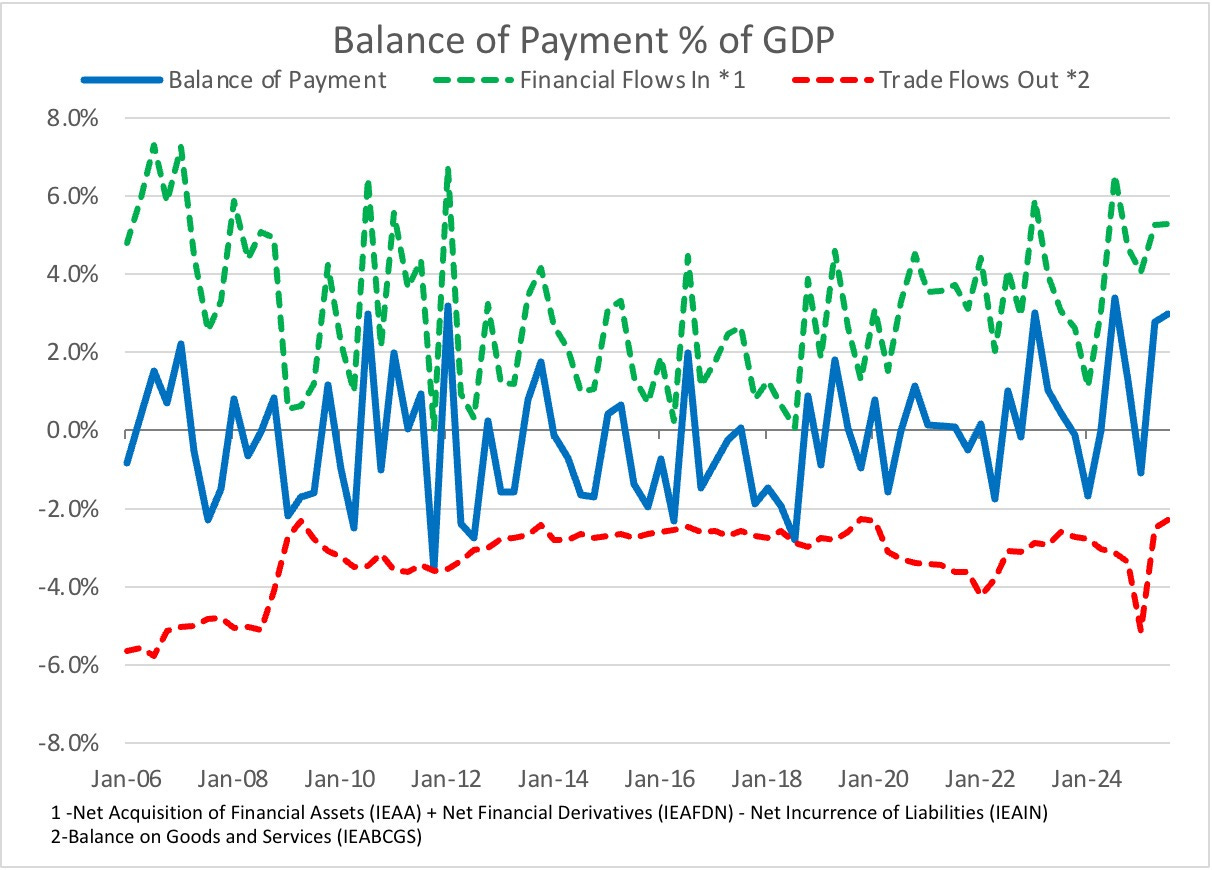
Section 122 allows the President to impose up to a 15% tariff for 150 days if there is a “large and serious” U.S. balance-of-payments deficits. Evidently the President is so claiming. As the chart below shows, it is hard to see how the current balance of payments is a large and serous deficit. However, if SCOTUS is unwilling to either declare Section 122 tariffs unconstitutional for either non-delegation doctrine and/or ambiguity of “large and serious”, Trump appears to have authority to impose these tariffs. And it would seem he could repeat this after the 150 days.
SCOTUS needs to either be willing to check a President that is not faithfully executing the law or find laws with ambiguous, ill-defined and/or open ended definitions unconstitutional.