

Federal Law 28 U.S. Code § 1442(a)(1) allows a company that is being tried in a State Court related to an act of the company to move the case to Federal Court if their act is related to their work for the Federal Government.
During World War II, the Federal government contracted with Chevron to produce aviation fuel, a critical war material. In fulfilling this contract Chevron, in significant part, relied on the refining of crude oil produced by Chevron.
In 2013 Plaquemines Parish Louisiana sued Chevron for environmental damage resulting from their crude oil production.
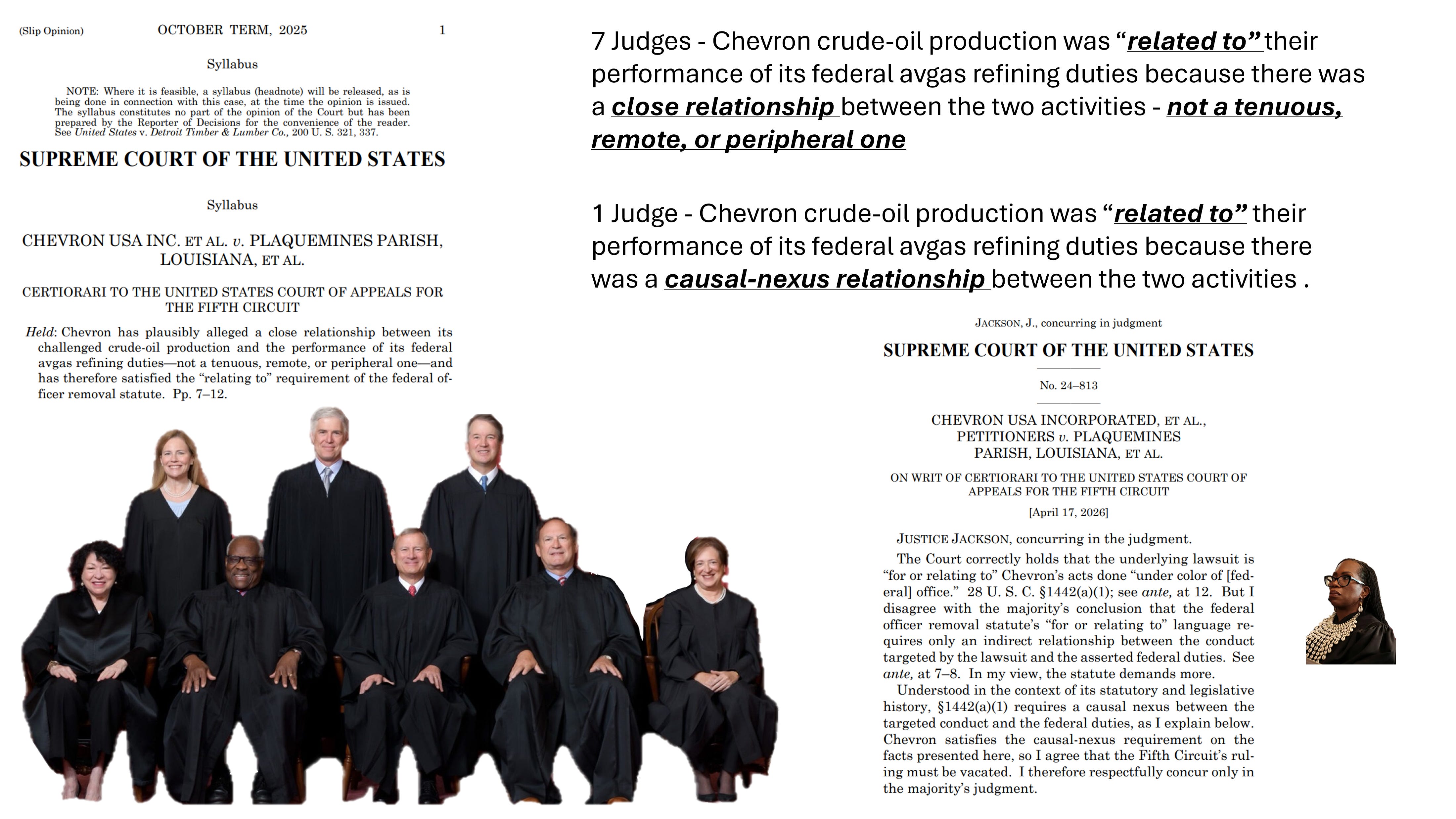
Yesterday, SCOTUS ruled 8-0 that Chevron can move the suits to Federal Court.
What is interesting to me is that seven Judges signed one opinion that essentially concluded that Chevron crude-oil production was “related to” their performance of its federal avgas refining duties because there was a close relationship between the two activities - not a tenuous, remote, or peripheral one. One Judge wrote a separate opinion that agreed with the result, but disagreed with the reasoning and wrote a separate opinion with a “different” reasoning.
The BIG difference: “causal-nexus” is significantly different from “closely related to.”
Not sure why the one Judge felt this distinction was worthy of a separate opinion. I am curious if this one Judge has experienced a life where they were often and frequently were treated differently with more deference and preferences to such an extent that they now think that they are uniquely special.
28 U.S. Code § 1442(a)(1) (a)A civil action or criminal prosecution that is commenced in a State court and that is against or directed to any of the following may be removed by them to the district court of the United States for the district and division embracing the place wherein it is pending: (1)The United States or any agency thereof or any officer (or any person acting under that officer) of the United States or of any agency thereof, in an official or individual capacity, for or relating to any act under color of such office or on account of any right, title or authority claimed under any Act of Congress for the apprehension or punishment of criminals or the collection of the revenue.