

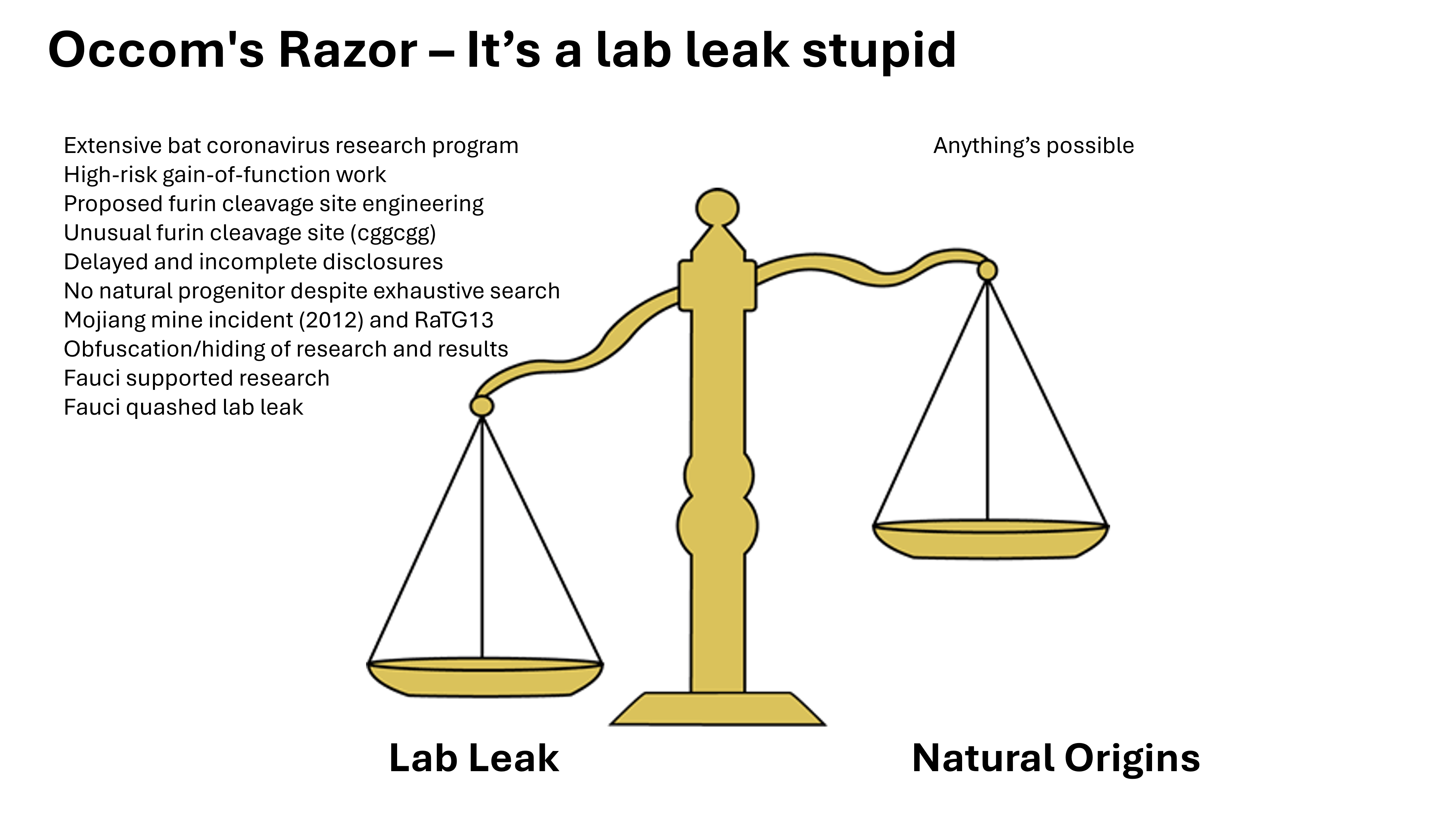
Facts Supporting a Laboratory Origin
China spent more than a decade collecting and studying one of the world’s largest known repositories of bat coronaviruses, particularly SARS-related coronaviruses (sarbecoviruses).
Chinese researchers, including those associated with the Wuhan Institute of Virology, were actively conducting high-risk coronavirus research involving chimeric viruses, humanized mouse models, serial passage experiments, receptor-binding studies, and other techniques designed to evaluate the potential for animal viruses to infect humans.
Chinese authorities disclosed the genome sequence of SARS-CoV-2 in early January 2020 after the outbreak had already begun in Wuhan.
In February 2020, China disclosed RaTG13 as the closest known coronavirus relative of SARS-CoV-2. However, the connection between RaTG13 and the previously published BtCoV/4991 sequence was not initially disclosed. BtCoV/4991 had been obtained from a mine in Mojiang, Yunnan Province, where several miners developed severe pneumonia-like illnesses in 2012.
SARS-CoV-2 contains a furin cleavage site (FCS), a feature not previously observed in any known member of the SARS-related coronavirus (sarbecovirus) lineage. The FCS includes a CGG-CGG codon pair that attracted attention because of its rarity among known sarbecoviruses.
Prior to the pandemic, researchers associated with EcoHealth Alliance and the Wuhan Institute of Virology proposed work that would have involved inserting furin cleavage sites into SARS-like bat coronaviruses.
The CGG codon is commonly used in molecular biology and genetic engineering because it efficiently encodes the amino acid arginine.
Despite extensive investigation and sampling efforts over several years, no direct natural ancestor of SARS-CoV-2 has been identified.
Despite extensive sampling of bat coronaviruses, no coronavirus containing the same SARS-CoV-2 furin cleavage site sequence has been identified.
Chinese authorities have limited access to key records, databases, laboratory information, sample inventories, and other data that could help clarify the virus’s origin.
Some coronavirus databases and research records that were previously accessible were removed from public access during the pandemic.
U.S. government funding, through EcoHealth Alliance, supported coronavirus research collaborations involving Chinese institutions, including the Wuhan Institute of Virology.
Evidence released through emails, congressional investigations, and intelligence disclosures indicates that Fauci and other influential officials played an active role in promoting the natural-origin narrative and downplaying the lab-leak hypothesis during the early stages of the pandemic.
Several recently discovered coronaviruses, including the BANAL viruses from Laos, are somewhat closer relatives of SARS-CoV-2 than RaTG13.
However, even the BANAL viruses remain evolutionarily distant from SARS-CoV-2 and do not provide a direct ancestral pathway explaining the emergence of COVID-19.
Critical details regarding the earliest COVID-19 cases, patient records, animal testing, and outbreak investigations in China remain incomplete or unavailable to outside investigators.
Facts Supporting Natural Origin
Natural zoonotic spillovers have occurred repeatedly throughout history and are a well-established mechanism for the emergence of new infectious diseases.
Some evidence suggests that a number of the earliest known COVID-19 cases were associated with the Huanan Seafood Market in Wuhan.
Environmental samples collected at the market tested positive for SARS-CoV-2, and some researchers argue that this pattern is consistent with a wildlife-associated spillover event.
Conclusion
Neither hypothesis has been conclusively proven. However, given the concentration of SARS-related coronavirus research in Wuhan, the existence of high-risk coronavirus experimentation, the unusual features of SARS-CoV-2, the lack of a confirmed natural progenitor after years of searching, and the continued opacity surrounding relevant Chinese data, the laboratory-origin hypothesis appears much more likely than a natural spillover explanation.
https://academic.oup.com/mbe/article/42/6/msaf118/8158589?login=false