

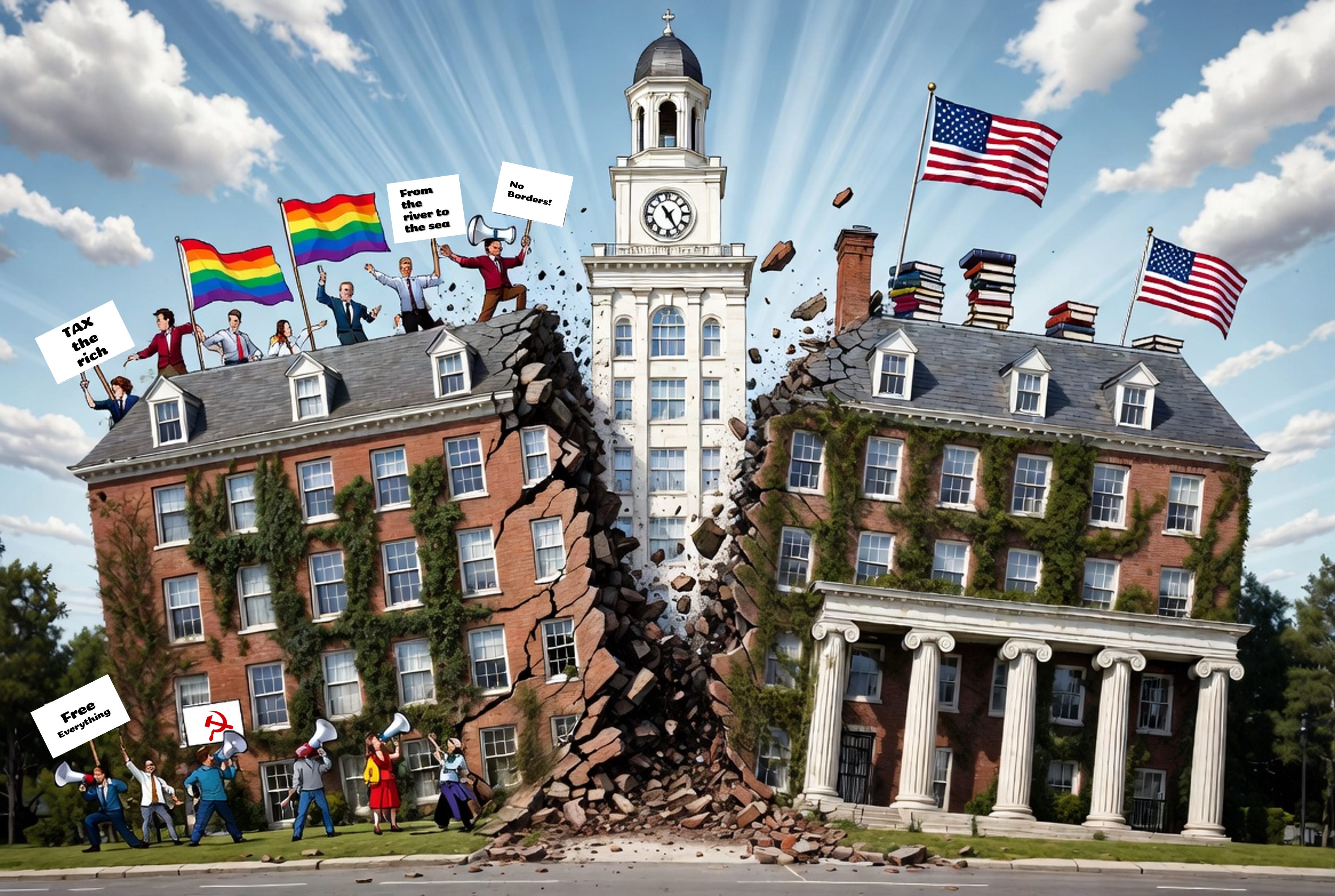
America’s higher education system—one of the nation’s most important and historically productive assets—is at serious risk.
Many of America’s most influential universities have become ideologically homogeneous, with progressive and far-left viewpoints now overwhelmingly dominating faculty, administration, and campus culture.
The data illustrate the scale of the shift. In 1969, self-identified liberals comprised about 45% of faculty, with conservatives and middle-of-the-road scholars each near 27-28%. By 2021-22, the liberal/far-left share had climbed to 74.2%, while middle-of-the-road faculty dropped to 14.9% and conservatives/far right to 10.8%. More recent surveys confirm the imbalance remains extreme, especially in the social sciences and humanities, where ratios of liberal to conservative faculty often exceed 10:1.
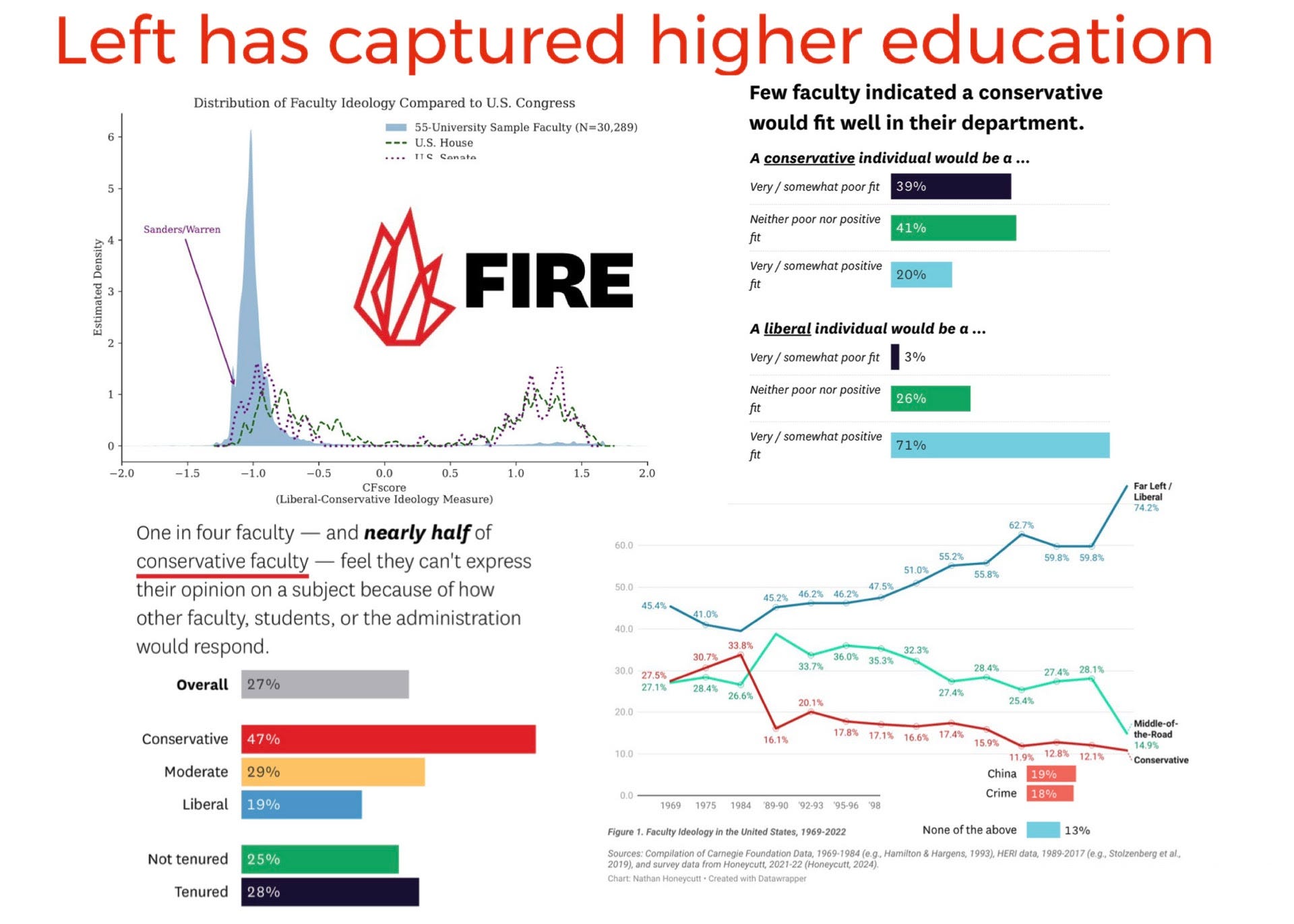
This ideological capture has transformed institutions dedicated to teaching students how to think into environments that too often dictate what to think. The consequences are measurable: widespread self-censorship—with nearly half of conservative faculty (47%) and 27% overall feeling unable to express their views due to fear of backlash from colleagues, students, or administrators—along with reduced open inquiry, declining public trust, and a chilling effect that harms everyone.
Restoring the university’s core mission requires recommitting to three mutually reinforcing pillars:
• Institutional Neutrality
Universities must actively restore ideological balance to their faculty, administration, and campus culture. Decades of one-sided hiring and promotion have created deeply entrenched monocultures that stifle dissent and undermine public confidence. Institutions should also refrain from issuing official statements on social and political issues unrelated to their core educational and research mission.
• Open Discourse
Faculty and students must be free to question prevailing ideas, voice dissenting opinions, and explore controversial topics without fear of social ostracism, professional retaliation, or administrative punishment. Robust, good-faith debate—even on uncomfortable subjects—is essential to intellectual progress.
• Academic Freedom
Faculty should have wide latitude to design courses, pursue research, and follow evidence wherever it leads—without dogmatic pressure from administrators, activist colleagues, or external groups.
These three principles reinforce one another. Institutional neutrality, combined with deliberate efforts to restore viewpoint diversity, creates the neutral ground on which open discourse and academic freedom can truly flourish. Without them, universities risk becoming echo chambers that prioritize ideological conformity over truth-seeking and critical thinking.
One promising model is the approach famously articulated in the University of Chicago’s 1967 Kalven Report: “The university is the home and sponsor of critics; it is not itself the critic.” By maintaining neutrality and deliberately broadening the range of viewpoints in hiring and leadership, universities can end the era of ideological gatekeeping, create space for genuine debate, and signal that no perspective is officially favored.
Several universities have successfully adopted or reaffirmed this approach in recent years, including Harvard, Stanford, Johns Hopkins, Vanderbilt, the University of North Carolina system, and smaller colleges such as Claremont McKenna College and the College of the Holy Cross. These examples show that neutrality paired with intentional rebalancing is practical and essential for rebuilding trust.
An insightful recent debate on this very question—“Is institutional neutrality necessary to preserve the university as a forum for open inquiry rather than an actor in political disputes?”—featured George Washington University Law Professor Jonathan Turley and Todd Wolfson, Professor at Rutgers University and President of the American Association of University Professors, sponsored by the Steamboat Institute. Watch here.
Follow on X @rggonzX