

The Constitution (Article 1 Section 4) empowers the States to determine how to elect their Representatives within whatever laws, if any, that Congress passes. To date the only law passed by Congress (2 U.S.C. § 2a) requires that any voting district have only one Representative and that voting districts in any state have equal population.
SCOTUS has ruled that the Supreme Court cannot stop political gerrymandering because the Constitution gives the states the power to decide how to run their elections other than the law which prevents multiple representatives in anny one district.
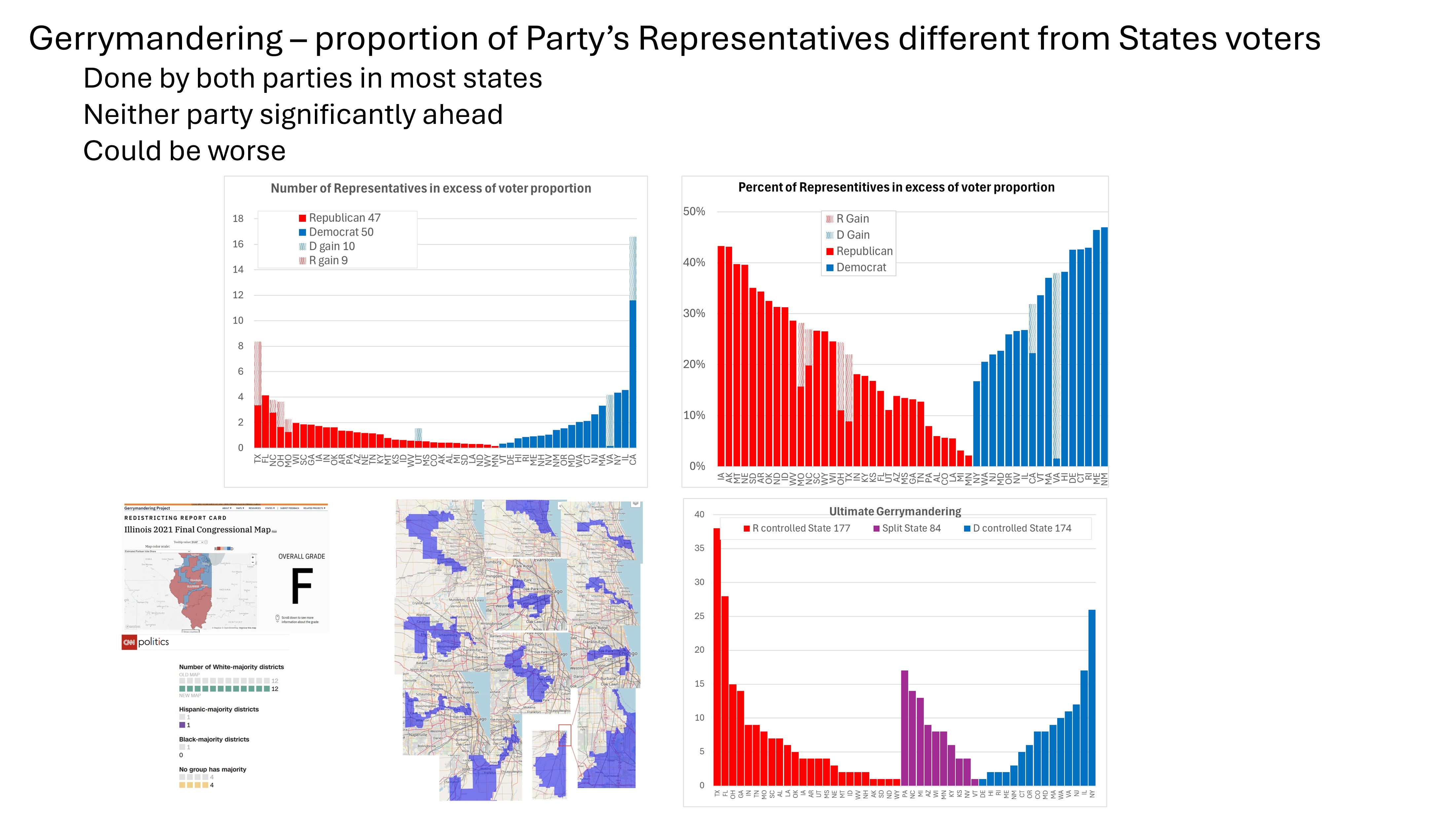
The result is that many states are gerrymandering where there is a disproportion between how the voters vote and how the Representatives are apportioned. There are two ways to look at the extent of gerrymandering. One is looking at the absolute number of Representatives and the other looking at the relative proportion.
The Voting Rights Act of 1965 Prevents the denial or abridgment of the right to vote on account of race, color, or membership in a language minority group. In the past, this prevented redistricting for the purpose of diluting the black vote. However, recent SCOTUS decisions appear to be recognizing that if a State districts to help Republicans it will hurt Democrats but if this is done for political purposes then it will be allowed.